
- .Naturally
Written By: HealthFitnessBloom Editorial Team
Reviewed By: HealthFitnessBloom Editorial Review Team
Last Updated: September 2026
Research Transparency: All studies are independently verified through PubMed, NIH, WHO, and peer-reviewed sleep science and clinical psychology databases.
Editorial Standards: Content reviewed against current scientific evidence. Claims cross-checked with PubMed, NIH, WHO, and primary journal sources. No sponsored influence on conclusions.
📋 Why We Created This Guide
“Inner peace” and “deep sleep” are among the most searched health topics globally — and among the most commercially exploited. Behind the supplements, the apps, and the curated wellness aesthetics is a body of genuinely useful neuroscience. This guide strips away the noise and explains what the research actually shows about achieving a calmer mind and deeper sleep through specific, evidence-supported practices

Table of Contents
For years I tried everything to sleep better — new mattress, apps, melatonin — and nothing worked. Then I realised I was solving the wrong problem. My body was ready to sleep. My mind was not. Once I understood that, everything changed.
Introduction
What Do “Inner Peace” and “Deep Sleep” Actually Mean?
Who Should Read This?
Key Statistics
Personal Story
Why the Calm Mind and Deep Sleep Are Connected
Research & Science
Calm Mind & Sleep Quality Audit
Quick Solutions
Simple Framework
Thinking Model
Original Insight
Featured Snippet
Practical Strategies
Common Mistakes
When To See a Doctor
Key Takeaways
FAQs
30-Day Calm Mind & Deep Sleep Plan
Final Thought
Conclusion
References
Disclaimer
Introduction
Most people trying to sleep better are solving the wrong problem. They change their mattress, download a new app, try melatonin, set the room temperature, and lie in the dark — still thinking. Still rerunning the day. Still composing tomorrow’s emails, relitigating yesterday’s conversations, narrating their own inability to sleep in real time. calm mind, inner peace, deep sleep, naturally
The body is willing to sleep. The mind will not allow it.
This is the central reality of most modern sleep difficulty — and it is not addressed by sleep hygiene advice, which typically treats the bedroom as the primary variable when the actual variable is the nervous system that enters it. A dysregulated nervous system — one that has spent the day in low-grade threat response, processing an unbroken stream of demands, news, and digital stimulation — does not transition to calm sleep simply because the lights are off.
Inner peace and deep sleep are not separate wellness goals. They are the same biological state approached from different angles. The mind that is calm enough for genuine peace is the mind that produces deep, restorative sleep. The practices that build one build both. This guide explains the science behind that connection and provides specific, evidence-supported strategies for achieving both – not through products, but through the deliberate cultivation of the neurological conditions that make genuine calm possible.

What Do “Inner Peace” and “Deep Sleep” Actually Mean?
Inner peace, in neurological terms, refers to a state of low default mode network (DMN) activity — reduced self-referential, ruminative thinking — combined with high prefrontal cortex regulation of the amygdala’s threat response. It is not the absence of thought. It is the absence of compulsive, distressing, self-amplifying thought. Research in contemplative neuroscience has identified this state as measurably distinct from ordinary rest and associated with specific brainwave patterns, reduced cortisol, and improved parasympathetic nervous system tone.
Deep sleep, clinically, refers to slow-wave sleep (NREM Stage 3) — the most physically and neurologically restorative sleep stage, during which growth hormone is released, the glymphatic system clears metabolic waste from the brain, and the immune system consolidates its defences. Most adults achieve their deepest slow-wave sleep in the first half of the night. Disrupted, shallow, or chemically suppressed sleep reduces this stage disproportionately.
In simple terms, inner peace and deep sleep are two expressions of the same biological state — a nervous system that has genuinely downregulated from threat-response mode and entered the parasympathetic calm in which both profound rest and true mental stillness become possible.
Who Should Read This?
Beginners who lie awake despite genuine tiredness and have never understood the neurological reason.
People struggling right now with a racing mind, shallow sleep, or a persistent sense of low-level anxiety that sleep doesn’t resolve.
Health-conscious readers who want to understand the neuroscience of calm and sleep beyond generic “sleep hygiene” checklists.
Lifestyle improvement seekers looking for specific, evidence-grounded daily practices that produce both genuine psychological calm and deeper, more restorative sleep.
Students or researchers interested in contemplative neuroscience, sleep architecture, vagal tone, and the psychophysiology of inner peace.
Key Statistics
The American Sleep Association estimates that 50–70 million Americans have chronic sleep disorders, with cognitive hyperarousal – an overactive, ruminative mind at bedtime – consistently identified as the most common contributing factor (ASA Sleep Statistics, 2024).
Research from the NIH confirms that deep slow-wave sleep is when the glymphatic system clears neurotoxic waste from the brain — including amyloid beta, a protein associated with Alzheimer’s disease — at a rate approximately tenfold greater than during wakefulness (NIH Brain Basics: Understanding Sleep).
A meta-analysis of mindfulness-based interventions published in JAMA Internal Medicine found that mindfulness meditation produced significant improvements in sleep quality, reduced insomnia severity, and decreased daytime fatigue compared to control conditions (JAMA Internal Medicine, 2015).
The WHO identifies chronic stress and mental health conditions as among the most significant contributors to sleep disorders globally (WHO Mental Health Fact Sheet, 2023).
Research published in Frontiers in Human Neuroscience found that slow-paced breathing at five to six cycles per minute produced measurable reductions in cortisol, increased heart rate variability (a key marker of nervous system calm), and improved both subjective and objective sleep quality within weeks of consistent daily practice (Frontiers in Human Neuroscience, 2018).
Personal Story
Fictional educational example — not a real individual.
Tariq, a 39-year-old architect, described himself as someone who “hadn’t truly rested in five years”. He slept – often eight hours – but woke unrefreshed, his mind already active before his alarm. Evenings were functional but never genuinely quiet. He described a persistent low hum of mental activity that had become so normalised he no longer recognised it as unusual.
A mindfulness-based stress reduction (MBSR) programme, initially attended reluctantly at his GP’s suggestion, changed his understanding of what rest actually required. “I realised I had never actually stopped,” he said. “I thought switching activities counted as rest. It didn’t.”
Twelve weeks of daily breathing practice, structured evening closure, and a revised relationship with his evening screen use produced the first genuinely quiet evenings he could remember — and, with them, the first sleep he described as “actually restorative”.
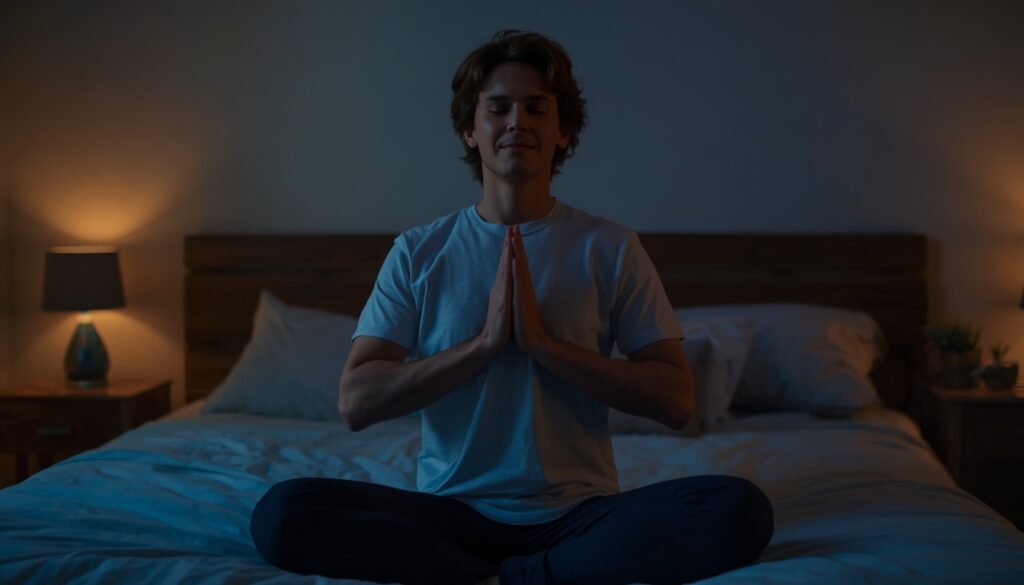
Why the Calm Mind and Deep Sleep Are Connected
Biological Reasons
What I learned is that inner peace and deep sleep are not two different goals — they are the same state of the nervous system. A calm mind and a sleeping body both require the same shift from stress mode to rest mode. When I learned to create that shift deliberately, both improved together.
The transition from wakefulness to deep sleep requires the nervous system to shift from sympathetic dominance (the alert, threat-monitoring state) to parasympathetic dominance (the rest-and-restore state). This shift is governed by the autonomic nervous system and is directly inhibited by cortisol, adrenaline, and the ruminative activity of the default mode network. A mind that is actively generating self-referential, anxious, or problem-solving thought — even at low intensity — maintains the neurochemical conditions incompatible with deep, slow-wave sleep. The prefrontal cortex’s regulatory function, which moderates the amygdala’s threat response, also declines with sleep deprivation — meaning poor sleep worsens the very cognitive dysregulation that prevented deep sleep in the first place.
Lifestyle Reasons
Several lifestyle patterns consistently prevent both inner calm and deep sleep. Evening screen exposure maintains cortisol and dopamine levels that delay the parasympathetic shift needed for sleep onset. Chronic psychological stress keeps the HPA axis activated, producing cortisol patterns incompatible with deep slow-wave sleep. Alcohol — used widely as a relaxant — suppresses REM sleep and produces lighter, more fragmented sleep in the second half of the night. The absence of a genuine cognitive closure practice — a structured transition between the demands of the day and the conditions for sleep — leaves the default mode network engaged with unresolved material precisely when it needs to disengage.
The racing mind at bedtime has specific, addressable neurological causes — our detailed guide on how to stop overthinking at night provides additional targeted techniques.
Common Barriers to Both
Chronic stress maintaining HPA axis activation incompatible with deep sleep
Evening screen use suppressing melatonin and maintaining cognitive arousal
No structured cognitive closure between the day and bedtime
Alcohol suppressing REM and producing fragmented second-half sleep
A conditioned association between bed and mental activity from habitual nighttime phone use
Research & Science
Study 1
Finding: A randomised controlled trial published in JAMA Internal Medicine found that mindfulness meditation significantly improved sleep quality, reduced insomnia severity, and decreased daytime fatigue compared to a sleep hygiene education control group — with effects attributed specifically to reduced pre-sleep cognitive arousal rather than relaxation per se.
What It Means For You: Mindfulness appears to improve sleep not primarily by relaxing the body but by training the brain’s capacity to observe thoughts without engaging them — a skill that directly addresses the ruminative mind activity that prevents sleep onset and deep sleep maintenance.
DOI: 10.1001/jamainternmed.2014.3656
PubMed: https://pubmed.ncbi.nlm.nih.gov/25686304/
Study 2
Finding: Research published in Frontiers in Human Neuroscience systematically reviewed psychophysiological studies on slow-paced breathing, finding that breathing at five to six cycles per minute consistently produced vagus nerve activation, increased heart rate variability, reduced cortisol and improved both subjective calm and objective sleep quality — with daily practice producing cumulative benefits over four to eight weeks.
What It Means For You: Slow breathing appears to be the most directly accessible, evidence-supported physiological intervention for the calm-sleep connection – working through the vagus nerve to shift the autonomic nervous system in real time, without equipment, medication, or significant time investment.
DOI: 10.3389/fnhum.2018.00353
PubMed: https://pubmed.ncbi.nlm.nih.gov/30245622/
Study 3
Finding: A study published in the Journal of Experimental Psychology: General found that writing a specific to-do list for the following day before bed – not journaling about the day, but offloading future tasks – reduced sleep-onset latency significantly compared to writing about completed activities, with the effect strongest when the list was highly specific and detailed.
What It Means For You: The mind’s reluctance to stop at night appears to be, in part, a functional attempt to maintain awareness of unfinished obligations. Giving those obligations a specific written plan appears to satisfy the monitoring function, freeing the mind to disengage — a practical insight with direct, evidence-supported application tonight.
DOI: 10.1037/xge0000374
PubMed: https://pubmed.ncbi.nlm.nih.gov/29045184/
For further reading, see the NIH National Center on Sleep Disorders Research, the American Academy of Sleep Medicine, and the WHO mental health resources.
Expert Insight:
Expert Perspective: Inner peace and deep sleep are not independent achievements that require separate interventions. They are two expressions of the same underlying neurological state — a nervous system that has genuinely, physiologically downregulated from the chronic low-grade activation that modern life normalises. The practices that produce one reliably support the other because they address the same root: a sympathetic nervous system that has not received a clear, consistent signal that the day is over.
Clinical Note: Persistent difficulty achieving either genuine calm or deep sleep — particularly when accompanied by significant anxiety, low mood, or daytime impairment — may reflect an underlying condition that lifestyle practices alone will not fully address. Professional support from a sleep medicine specialist, psychologist, or GP is appropriate when self-directed strategies have been consistently applied for four to six weeks without meaningful improvement.

Calm Mind & Sleep Quality Audit
Rate each statement from 0 (never) to 3 (almost always):

Statement
Score (0–3)
My mind is active and busy when I lie down to sleep
___
I use screens (phone, TV, laptop) within 60 minutes of bedtime
___
I rarely feel genuinely calm at any point during the day
___
I wake during the night and struggle to return to sleep
___
I drink alcohol within three hours of bedtime
___
I have no structured transition between my working day and bedtime
___
I feel unrefreshed in the morning despite adequate sleep hours
___
I regularly feel that tomorrow’s tasks and concerns follow me to bed
___
Score Guide:
0–8: Mild barriers — one or two targeted practices will likely produce meaningful improvement.
9–16: Moderate barriers — a structured multi-practice approach from this guide is recommended; review alcohol and screen habits first.
17–24: Significant barriers — a combined lifestyle approach is strongly recommended alongside professional support if the score does not improve within four weeks.
Priority Flags:
Row 5 scores 2–3: Alcohol is likely suppressing deep sleep — address this before any other intervention.
Rows 1 and 8 both score 2–3: cognitive closure practice is the most important first step.
Row 7 scores 3: Consider whether an underlying sleep condition (apnoea, thyroid) requires medical evaluation.
Reflective tool only — not a diagnostic instrument.
Quick Solutions
Evidence-supported steps that produce measurable effects tonight and this week:
Write tomorrow’s specific to-do list before bed — offloading unfinished mental tasks into written form reduces pre-sleep cognitive arousal within the same night (RCT evidence).
Practice 4–6 slow breaths before sleeping — four counts in, six counts out for five minutes activates the vagus nerve and begins the parasympathetic shift within minutes.
Remove alcohol from within three hours of bedtime — alcohol suppresses REM and deep sleep in the second half of the night; this single change improves sleep architecture measurably.
Put your phone in another room tonight — removing the primary cognitive stimulation trigger from the bedroom begins reconditioning the bed as a sleep-only space.
Dim all lights after 9 PM — dim lighting supports melatonin rise and begins the physiological transition towards sleep two hours before bedtime.
Name one thing you are genuinely looking forward to tomorrow — this brief reorientation away from threat and towards anticipation modulates the amygdala’s pre-sleep activity.
Take a warm shower or bath 60–90 minutes before bed — the subsequent core temperature drop is one of the most reliable physiological signals for deep sleep onset.
Calm evenings and deep sleep are built in the morning—read our guide on simple daily habits for productivity without stress to build a calmer, more intentional daily architecture.
Simple Framework
Step
Action
Ask Yourself
1
Diagnose
Use the Calm Mind Audit – what is my primary barrier to calm and deep sleep?
2
Close the day.
What structured practice can I use to signal to my nervous system that the day is genuinely over?
3
Protect the Night
What is the single biggest input I can remove from my evening to protect the transition to calm sleep?
This framework prioritises cognitive closure — the deliberate act of ending the day mentally, not just physically — because this is the most commonly missing element for people who struggle with both inner peace and deep sleep. The evening is too often experienced as an unstructured continuation of the day rather than a deliberate transition away from it.
Thinking Model
Question 1: Why is this happening?
Ask honestly whether your evenings contain any genuine signal to your nervous system that the demands are over. Most people’s evenings are passive extensions of the day — screens showing content as stimulating as the workday, social media providing the same comparison and threat-response triggers, phones within reach maintaining low-level vigilance. In the absence of a clear physiological and behavioural “the day is over” signal, the nervous system remains on standby. That standby is the enemy of both inner peace and deep sleep.
Question 2: What am I missing?
Most people seeking better sleep are missing deliberate parasympathetic activation — specific, consistent daily practices that shift the nervous system from sympathetic to parasympathetic dominance before bed. Not passive relaxation (watching TV), but active parasympathetic activation: slow breathing, gentle movement, structured cognitive closure, and reduced light exposure. These are not the same thing, and they produce measurably different physiological outcomes.
Question 3: What should I change first?
Start with what you remove, not what you add. Identifying the single evening habit most actively maintaining your nervous system’s arousal — typically either alcohol or screen use in the hour before bed — and removing it produces a more immediate and reliable improvement than adding a new practice on top of an unchanged disruptive environment.
Original Insight
Here is the truth that most sleep and wellness advice dances around without stating directly: inner peace is not a feeling you achieve. It is a nervous system state you create the conditions for.
The cultural framing of inner peace as something discovered, received, or unlocked through the right retreat, the right mindset, or the right supplement misses the biological reality entirely. Genuine calm — the kind that produces deep sleep and carries into the following day — is the output of a nervous system that has been given consistent, reliable signals that it is safe, that the demands are paused, and that recovery is available.
Those signals are not mystical. They are physiological. Dim light. Slow breathing. A body that has moved today. A mind that has closed its tabs before bed. A sleep environment that the brain has learned to associate with rest rather than stimulation. Warmth followed by cooling. Stillness chosen rather than accidentally encountered.
You do not find inner peace. You build the conditions in which it becomes the default. And those conditions are, without exception, built from consistent, daily, unglamorous choices that compound over weeks until the nervous system learns — gradually, genuinely — that it is allowed to rest.

Featured Snippet
Yes, inner peace and deep sleep are neurologically connected states – both require the same shift from sympathetic nervous system dominance (active, alert, cortisol-driven) to parasympathetic dominance (restful, calm, recovery-focused). Evidence-based practices that appear to support both simultaneously include slow diaphragmatic breathing, structured cognitive closure, consistent sleep timing, mindfulness training, and specific environmental conditions.
Practice
Primary Mechanism
Evidence Level
Timeline
Slow breathing (5–6 cycles/min)
Vagus nerve activation, cortisol reduction
Strong (systematic review)
Minutes to weeks
Pre-sleep to-do list (specific tasks)
Offloads unresolved tasks, reduces cognitive arousal
Strong (RCT)
Same night
Mindfulness meditation (daily, 8+ weeks)
DMN quieting, prefrontal amygdala regulation
Strong (meta-analysis)
4–8 weeks
Consistent wake time (7 days/week)
Circadian anchor for deep sleep architecture
Strong
1–2 weeks
No alcohol within 3 hrs of bed
Protects REM and second-half deep sleep
Very Strong
Same night
Screen-free 60 min before sleep
Melatonin protection, reduced cognitive activation
Moderate–Strong
Days
Warm bath 60–90 min before bed
Core temperature drop triggers deep sleep onset
Moderate–Strong
Same night
Key Action Summary:
✅ Slow breathing daily | ✅ Write tomorrow’s tasks before bed | ✅ No alcohol within 3 hrs | ✅ Screen-free last hour | ✅ Consistent wake time
Practical Strategies
Strategy 1 — Build a Daily Slow Breathing Practice
Slow breathing at five to six breath cycles per minute — approximately five seconds in and five seconds out — is the most directly accessible physiological intervention for the calm-sleep connection. It activates the vagus nerve, shifts the autonomic nervous system toward parasympathetic dominance, reduces cortisol, and increases heart rate variability (a reliable marker of nervous system calm). Practising for five to ten minutes daily — ideally in the hour before bed — this produces cumulative benefits over four to eight weeks that extend beyond sleep into daytime stress resilience. An architect who introduced five minutes of slow breathing after dinner described it as “the first thing that actually worked” after years of sleep difficulty, noticing reduced sleep-onset time within the first week.
Strategy 2 — Create a Structured Cognitive Closure Ritual
The default mode network — the brain’s self-referential thought-generating system — does not disengage simply because you intend to sleep. It disengages when it receives specific signals that its monitoring function is no longer needed. The most evidence-supported method for providing this signal is a written pre-sleep cognitive closure ritual: a specific to-do list for tomorrow (not a journal, not a gratitude list — a concrete action plan), combined with a brief mental or written review of the day’s completions. This combination signals both “the future is planned” and “the past is acknowledged” – removing the two primary drivers of nighttime rumination. Practised nightly for two to three weeks, this tends to produce a noticeable reduction in the “busy mind at bedtime” pattern.
Strategy 3 — Practise Mindfulness as a Daytime Skill
The consistent finding across mindfulness and sleep research is that mindfulness appears to improve sleep primarily through a daytime mechanism — the trained capacity to observe thoughts without being pulled into them — that then applies automatically in the pre-sleep state. This is why a ten-minute daily mindfulness practice (not meditation specifically, but the deliberate practice of noticing thoughts as events rather than facts) produces better sleep outcomes over eight to twelve weeks than most bedtime-only interventions. Someone who described their mind as “a browser with too many tabs” found that a ten-minute morning mindfulness practice, sustained over eight weeks, gradually reduced the tabs — with sleep improvement following two to three weeks after mood improvement.
Strategy 4 — Anchor Sleep With a Consistent Wake Time
The most powerful single variable for deep sleep architecture is not bedtime but wake time. Consistent wake timing — held seven days per week — anchors the circadian signal that governs when cortisol rises, when melatonin falls, and when the brain distributes slow-wave deep sleep most efficiently across the night. Weekend variation of more than 90 minutes from weekday wake time creates the equivalent of weekly jet lag — reducing deep sleep efficiency for the following two to three nights. Setting and holding a consistent wake time for two weeks, before making any other change, typically produces a noticeable improvement in sleep depth and morning alertness.
Strategy 5 — Design a Sleep Environment That Signals Rest
The bedroom environment communicates to the brain before sleep begins. A room in which work is done, phones are used, news is consumed, and stress is experienced trains the brain to associate that environment with alertness rather than sleep. Environmental changes that appear to support both calm and deep sleep include a temperature of 16–19°C (60–67°F), complete darkness (blackout curtains or eye mask), removal of all screens and work-related items, and a consistent pre-sleep sensory sequence (the same light, sound, and activity pattern nightly) that the nervous system learns to associate with the approach of sleep.
Strategy 6 — Use Physical Movement to Support Nighttime Calm
Regular aerobic exercise — twenty to thirty minutes of moderate intensity, three to five times per week — appears to improve deep slow-wave sleep proportion and reduce pre-sleep anxiety through multiple mechanisms: reduced baseline cortisol, increased adenosine buildup (the sleep pressure molecule), and improved vagal tone. The timing matters: exercise completed more than three hours before bed appears to support sleep; vigorous exercise immediately before bed may maintain arousal for some people. Someone who began three thirty-minute walks per week reported measurably deeper sleep — described as “heavier, less breakable” — within three weeks, without any other changes.
Walking is among the most accessible and evidence-supported sleep-supporting activities available — discover the science in our guide on the quiet power of walking for mental health and sleep.
Strategy 7 — Address the Stress Upstream, Not Only at Bedtime
The calm that produces deep sleep does not begin at 10 PM. It is built across the day — through brief restorative breaks, adequate physical movement, genuine social connection, and the reduction of unnecessary chronic stressors. A daily micro-recovery practice — five minutes of deliberate non-stimulating rest between demanding tasks, a genuine lunch break away from screens, or a short outdoor walk — reduces the cortisol burden arriving at bedtime. Someone who introduced a genuine twenty-minute screen-free lunch break described it as “accidentally becoming calmer by evening” within two weeks — without any bedtime intervention.
The calm that produces deep sleep is built across the whole day — our comprehensive guide on managing daily stress naturally provides the daytime tools that make evening calm possible.
Common Mistakes
Mistake
Why It Fails
Fix
Using alcohol to relax before sleep
Suppresses REM and deep sleep — produces lighter, more fragmented sleep in the second half of the night
Replace alcohol with slow breathing or a warm bath as the evening relaxation signal
Treating passive TV-watching as rest
Maintains cortisol and cognitive engagement — not the same as parasympathetic activation
Distinguish between distraction (stimulation) and genuine rest (downregulation)
Attempting meditation only on bad sleep nights
Mindfulness benefits are cumulative — occasional use produces minimal lasting benefit
Practise for five to ten minutes daily regardless of sleep quality the previous night
Weekend lie-ins to compensate for the week
Disrupts circadian timing and reduces deep sleep efficiency for Monday through Wednesday
Hold consistent wake time seven days; use brief early-afternoon naps if needed
Adding new bedtime practices without removing disruptors
New practices cannot fully compensate for alcohol, screens, and inconsistent timing still present
Remove one significant disruptor before adding a new practice
Expecting results within two to three days
Nervous system recalibration takes two to six weeks of consistent practice
Track progress weekly, not daily — the trend matters more than any single night
When To See a Doctor
Please seek professional evaluation if sleep difficulty has persisted for more than four weeks despite consistent lifestyle changes, if you snore loudly or wake with headaches, if your partner has observed breathing pauses during sleep, or if daytime functioning is significantly impaired. These may indicate sleep apnoea or another medical cause of sleep disruption that no lifestyle practice will fully address.
If anxiety or low mood accompanies persistent sleep difficulty, a GP referral to a psychologist or a CBT for insomnia (CBT-I) programme is the most evidence-supported clinical next step — significantly more effective than sleep medication for most people with psychological contributors to sleep disruption.
If sleep disruption persists despite consistent effort, a medical cause may be present — our guide on understanding stress, anxiety, and depression explains the most important conditions to rule out.
Key Takeaways
Inner peace and deep sleep are two expressions of the same biological state — a nervous system in genuine parasympathetic dominance.
Slow breathing at five to six cycles per minute is the most directly accessible physiological intervention, activating the vagus nerve and reducing cortisol within minutes and cumulatively over weeks.
Writing a specific to-do list before bed – not journaling – reduces sleep-onset time by offloading unresolved task monitoring from the brain (RCT evidence).
Mindfulness training improves sleep primarily through a daytime mechanism: training the brain to observe thoughts rather than be consumed by them.
Alcohol, irregular wake times, and evening screen use are the three most reliable disruptors of both inner calm and deep sleep.
Inner peace is not found — it is built from consistent daily conditions that the nervous system learns to recognise as safe for genuine rest.
Professional support (CBT-I, sleep medicine) is appropriate when self-directed strategies have not produced improvement within four to six weeks.
FAQs
1. What is the fastest natural way to calm a racing mind at night?
Slow breathing — extending the exhale to twice the length of the inhale — activates the vagus nerve and begins shifting the autonomic nervous system toward calm within 60–90 seconds. Combined with lying still and focusing attention on the physical sensation of breathing, this is the fastest evidence-supported technique for interrupting the nighttime thought spiral.
2. Is melatonin effective for improving deep sleep?
Melatonin may help with sleep timing — particularly for jet lag and circadian shifts — but has limited evidence for improving deep sleep quality or duration in people with ordinary insomnia. The practices in this guide that address deep sleep architecture (consistent wake time, alcohol reduction, temperature, slow breathing) have stronger evidence for improving actual sleep depth.
3. How does mindfulness improve sleep?
Mindfulness appears to improve sleep primarily by training the observer function of the prefrontal cortex — the ability to notice thoughts as passing events without being pulled into them. This reduces the ruminative activity that prevents sleep onset and deep sleep maintenance, with effects that appear after several weeks of consistent daily practice.
4. Does exercise timing affect sleep quality?
Research suggests moderate aerobic exercise completed more than three hours before bed supports deep sleep by increasing adenosine (sleep pressure) and reducing baseline cortisol. For most people, morning or early-afternoon exercise has the most reliable positive effect on that night’s sleep quality.
5. Can inner peace genuinely be cultivated, or is it a personality trait?
Research in contemplative neuroscience — including neuroimaging studies of long-term meditators — shows that the brain states associated with inner peace are measurably trainable, not fixed. Regular mindfulness practice produces documentable changes in prefrontal-amygdala connectivity, default mode network activity, and cortisol regulation over eight to twelve weeks in participants without prior meditation experience.
6. Why does alcohol make me feel sleepy but sleep worse?
Alcohol is sedating and reduces sleep-onset time — which is why it feels like it helps. But its metabolism in the second half of the night produces acetaldehyde, which stimulates the nervous system, suppresses REM sleep, and produces lighter, more fragmented sleep during the hours (3–7 AM for most people) when deep and REM sleep should dominate.
7. How long before results from these practices are noticeable?
Most people notice some improvement in sleep-onset time and morning feeling within one to two weeks of removing major disruptors (alcohol, screens, and irregular timing). More substantial improvements in deep sleep quality and daytime calm typically require four to eight weeks of consistent practice — nervous system recalibration is a gradual process, not a switch.
30-Day Calm Mind & Deep Sleep Plan
Week 1 — Audit and Remove
Complete the Calm Mind & Sleep Audit. Identify your highest-scoring rows. Remove the single most disruptive evening habit — typically alcohol within three hours of bed, or screens in the final hour. Set a consistent wake time and hold it every day including weekends. Write tomorrow’s specific task list before bed every night this week.
Week 2 — Activate and Anchor
Maintain Week 1 changes. Add a five-minute slow breathing practice each evening – before bed or after dinner. Begin dimming lights at 9 PM. Move your phone charger to another room. Add one moderate aerobic activity (a 20–30 min walk) three times this week specifically for sleep support.
Week 3 — Deepen and Train
Add a ten-minute daily mindfulness practice — morning is most effective for building the daytime skill that transfers to nighttime. Begin a structured cognitive closure: written task list plus a one-minute mental acknowledgement of what was completed today. Assess your sleep environment — temperature, darkness, and stimulus removal.
Week 4 — Consolidate and Review
Compare your current experience to Week 1. Which practices produced the clearest improvement? Commit to those as permanent daily habits. If sleep quality remains significantly impaired despite consistent effort, book a GP appointment this week — sleep apnoea, thyroid dysfunction, or anxiety disorder may require professional assessment.
Final Thought
Inner peace does not announce itself. It arrives quietly – one evening when you notice the default background hum has softened, or one morning when the alarm doesn’t feel like an emergency. You built it, gradually, from choices most people considered too small to matter.
Conclusion
My honest advice is to stop chasing sleep and start building calm. Breathe slowly before bed, write tomorrow’s tasks down, cut alcohol, and keep your wake time consistent. Do it for weeks, not nights. The quiet arrives gradually — and when it does, you will know you built it yourself.
The calm mind and the deeply sleeping mind are not separate achievements requiring separate solutions. They are the same nervous system state, approached from slightly different angles, built from the same consistent daily conditions: a body that has moved, a mind that has genuinely closed the day, a nervous system that has received the signal — through breath, through stillness, through deliberate environmental design — that recovery is now permitted. The practices described here are not complicated. They are consistent. And consistency, over four to eight weeks, is what produces the kind of genuine rest that no supplement has ever been able to replicate.calm mind, inner peace, deep sleep, naturally
References
American Sleep Association. Sleep Statistics — Adults. ASA, 2024. https://www.sleepassociation.org/about-sleep/sleep-statistics/
NIH National Institute of Neurological Disorders and Stroke. Brain Basics: Understanding Sleep. NIH, 2023. https://www.ninds.nih.gov/health-information/public-education/brain-basics/brain-basics-underst
World Health Organization. Mental Health: Strengthening Our Response. WHO, 2023. https://www.who.int/news-room/fact-sheets/detail/mental-health-strengthening-our-response
American Academy of Sleep Medicine. Sleep Disorders Resources. AASM, 2024. https://aasm.org/resources/
Black DS, O’Reilly GA, Olmstead R, et al. Mindfulness Meditation and Improvement in Sleep Quality and Daytime Impairment Among Older Adults. JAMA Internal Medicine. 2015. DOI: 10.1001/jamainternmed.2014.3656. PubMed: https://pubmed.ncbi.nlm.nih.gov/25686304/
Zaccaro A, Piarulli A, Laurino M, et al. How Breath-Control Can Change Your Life: A Systematic Review on Psycho-Physiological Correlates of Slow Breathing. Frontiers in Human Neuroscience. 2018. DOI: 10.3389/fnhum.2018.00353. PubMed: https://pubmed.ncbi.nlm.nih.gov/30245622/
Scullin MK, Krueger ML, Ballard HK, et al. The Effects of Bedtime Writing on Difficulty Falling Asleep. Journal of Experimental Psychology: General. 2018. DOI: 10.1037/xge0000374. PubMed: https://pubmed.ncbi.nlm.nih.gov/29045184/
Ebrahim IO, Shapiro CM, Williams AJ, et al. Alcohol and Sleep I: Effects on Normal Sleep. Alcoholism: Clinical and Experimental Research. 2013. DOI: 10.1111/acer.12006. PubMed: https://pubmed.ncbi.nlm.nih.gov/23347102/
Xie L, Kang H, Xu Q, et al. Sleep Drives Metabolite Clearance from the Adult Brain. Science. 2013. DOI: 10.1126/science.1241224. PubMed: https://pubmed.ncbi.nlm.nih.gov/24136970/
Mailing LJ, Allen JM, Buford TW, et al. Exercise and the Gut Microbiome. Exercise and Sport Sciences Reviews. 2019. DOI: 10.1249/JES.0000000000000183. PubMed: https://pubmed.ncbi.nlm.nih.gov/30883418/
Czeisler CA, et al. Stability and Precision of the Human Circadian Pacemaker. Science. 1999. DOI: 10.1126/science.284.5423.2177. PubMed: https://pubmed.ncbi.nlm.nih.gov/10381883/
Kuyken W, Warren FC, Taylor RS, et al. Efficacy of Mindfulness-Based Cognitive Therapy in Prevention of Depressive Relapse. JAMA Psychiatry. 2016. DOI: 10.1001/jamapsychiatry. 2016.0076. PubMed: https://pubmed.ncbi.nlm.nih.gov/27119968/
Note: All references should be independently re-verified for accuracy before publication.
Disclaimer
This article is for educational and informational purposes only. It does not constitute medical or psychological advice and is not a substitute for professional healthcare. If you experience persistent sleep disruption, anxiety, or other health concerns, please consult a qualified healthcare professional. Individual responses to the practices described vary.
About the Author
HealthFitnessBloom Editorial Team
HealthFitnessBloom is dedicated to providing science-backed health, fitness, and wellness information to help readers live healthier lives. Our editorial team researches, writes, and reviews content to ensure accuracy, clarity, and practical value.